Describe How Light Changes With Depth in the Ocean
The ocean can be divided from its surface to its depth into three zones based on the amount of light received. It is generally a very dim region but it does receive a sliver of sunlight at the midday point which is enough for photosynthesis to occur.
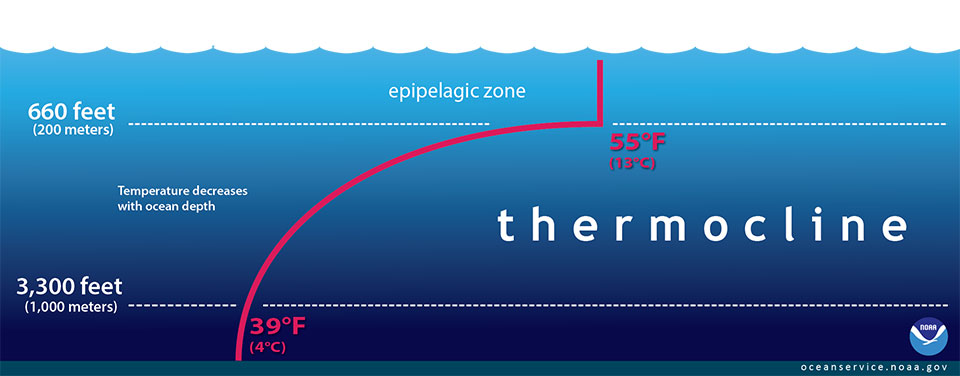
What Is A Thermocline
As depth increases so does pressure.
. Middle of the ocean on water. Here there is enough light penetrating the water to support photosynthesis. Which of the following statements correctly describe light refraction in water.
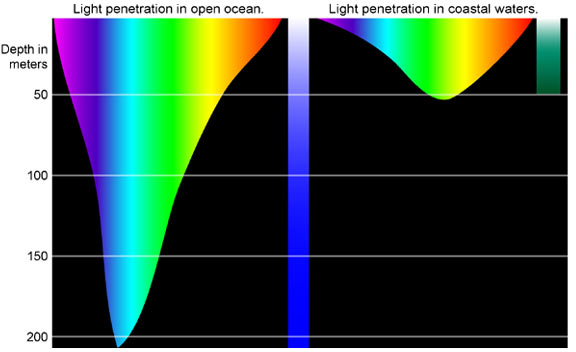
It is located at 150 - 400 m depth in the tropics and at 400 - 1000 m depth in the. Blue light penetrates best green light is second yellow light is third followed by orange light and red light. Transitional waves are waves traveling in water where depth is less than half the wavelength but greater than one-twentieth the wavelength 120 L D 12 L.
Deeper currents are driven by changes in water density. The temperature of the Atlantic Ocean can be between 28-84 degrees Fahrenheit. Define upwelling and explain its importance.
What are some descriptive words for the Ocean. Upwelling is the movement of cold water upward from the deep ocean. The visible spectrum consists of wavelengths between 390 and 750 nanometers nm Table 1.
This zone has the highest levels of sunlight photosynthesis and dissolved oxygen. Transitional waves are often wind-generated waves that have moved into shallower water. Many large predatory fish live here.
The color of the ocean surface for the most part is based on depth whats in it and whats below it A glass of water will of course appear clear as visible light passes through it with little to no obstruction. The sea surface temperatures range from as high as 97F 36C in the Persian Gulf to 28F -2C near the North Pole. This is the top layer nearest the surface.
Red light is quickly filtered from water as depth increases and red light effectively never reaches the deep ocean meaning animals that live in deep water and are red are essentially invisible. Surface currents in the top 400 m are driven mainly by wind. Choose all that apply Light refraction occurs in deep water.
But if a body of water is deep enough that light isnt reflected off the bottom it appears blue. Light refraction causes an object to appear in a different location than it really is. The compensation depth obviously varies continually with changes of illumination and must be defined with respect to time and place.
It moves water heat salt and nutrients around the world. Ocean words are listed in alphabetical order. The twilight zone or the mesopelagic zone begins at 200 meters and extends downward to 1000 meters making up approximately 20 percent of the oceans total depth.
It is in this zone that most of the visible light exists. Total number of ocean words and adjectives. Light is bent as it moves from air to water due to a change in the speed of light.
Only about 25 percent of incident light reaches a depth of 10 meters in the open ocean where water is very clear. Pressure increases with ocean depth. At greater depth ocean life also become more narrow of body.
This vehicle allows scientists to observe the deep sea under tremendous ocean pressure. Even at the equator the average temperature is as low as 49º C. It is also called the euphotic zone.
It absorbs infrared light quickly little infrared light penetrates more than 2 meters. In high latitudes in summer the noon compensation depth commonly lies somewhere between 10 and 60 m. Both types of currents work with the atmosphere to help shape the Earths climate.
The depth of the ocean though is from 11000-13000 feet Atlantic Ocean. In clear water in the tropics the noon compensation depth may be well below 100 m throughout the year. The euphoticzone is from the surface of the ocean down 200 meters.
Most of the visible light spectrum is absorbed within 10 meters 33 feet of the waters surface and almost none penetrates below 150 meters 490 feet of water depth even when the water is very clear. Little or no light penetrates this part of the ocean and most of the organisms that live there rely for subsistence on falling organic matter produced in the photic zone. With the light comes heating from sun.
Greater abundances of solid particles in. Light changes with the depth in the ocean because as you descend less light travels so it becomes darker. Aqua aquamarine aquatic Atlantic beautiful blue brave briny calm Caribbean cerulean cloud continuous crushing force crystal clear.
The average ocean temperature is 38º C. For this reason scientists once assumed that life would be sparse. Light is quenched rather quickly even in clear water.
Here is a list of words that describe the ocean. The deep sea or deep layer is the lowest layer in the ocean existing below the thermocline and above the seabed at a depth of 1000 fathoms or more. Deep-water waves include all wind-generated waves moving across the open ocean.
This is also for the water of the Atlantic Ocean as well What is the. Pisces V is a three-person submersible that can operate at depths up to 6500 feet. This zone is also sometimes called the sunlight zone because there is enough sunlight to have photosynthesis.
The layer where the temperature changes rapidly with depth which is found in the temperature range 8 - 15º C is called the permanent thermocline. This heating is responsible for wide change in temperature that occurs in this zone both in the latitude and each season. The ocean has a complex circulation system called the Global Ocean Conveyor.
Light lessens temperature drops and the water becomes more dense due to increased salinity.

Layers Of The Ocean Physical Geography

Dive And Discover Hot Topics Deep Sea Biology Oceanography Earth And Space Science Oceanography Marine Biology
6 5 Light Introduction To Oceanography


Comments
Post a Comment